Day Trips from Kutaisi, Georgia: The Best Options
The best day trips from Kutaisi split cleanly into four directions, and the biggest mistake travelers make is trying to combine sites from more than one of them in a single day. North and east of the city, Gelati Monastery, Motsameta Monastery, Tskaltubo, and Prometheus Cave sit close enough together to cover comfortably in one day. West, Okatse Canyon, Kinchkha Waterfall, and Martvili Canyon are each worth the drive but spread out enough that most visitors pick one canyon area per day. Further east, Chiatura and the Katskhi Pillar are their own full-day detour into Soviet industrial history. And south, Batumi is reachable but really needs more than a rushed afternoon to be worth the two-hour drive each way.
Why This Matters More Than It Sounds
Kutaisi itself is compact — a cathedral, a market, a river walk, most of it doable on foot in a day or two. What actually fills out a Kutaisi-based trip is everything around it: a UNESCO monastery complex, a spa town of abandoned Soviet sanatoriums, two of the more dramatic canyons in the Caucasus, and a cave system with a boat tour through it. All of that sits within roughly an hour and a half of the city, which is exactly why Kutaisi works as a base in the first place.
The catch is that “within an hour and a half” doesn’t mean “all in the same direction.” Georgia’s back roads and marshrutka schedules mean a day trying to hit both a canyon and a monastery usually turns into a day spent mostly in transit, with disappointing time left at either stop. Planning by direction rather than by destination is what actually determines whether a two- or three-day stay in Kutaisi feels unhurried or frantic.
A Composite Case: The Day That Tried to Do Too Much
Picture a fairly common plan: two nights in Kutaisi, one full day free, and a list that includes Gelati Monastery, Prometheus Cave, and Martvili Canyon. That’s a composite itinerary, not one specific trip, but it’s close to how a lot of first Kutaisi day-trip plans get built — pick the three names that come up most in searches and assume a rental car can connect them.
In practice, Gelati sits northeast of Kutaisi, Prometheus Cave is a few kilometers past Tskaltubo to the north, and Martvili Canyon is nearly an hour southwest, on the opposite side of the city entirely. A traveler working through that list in order spends a meaningful chunk of the day backtracking through Kutaisi itself to get from the north side to the southwest side, and arrives at Martvili with less daylight — and less patience — than the canyon deserves. Dropping Martvili for a second day, or swapping it for something closer to the monastery-and-cave cluster, would have used the same single day far better.
The Pattern Worth Remembering
Group the trip by direction, not by whichever names sound most appealing. Kutaisi’s genuinely worthwhile day trips cluster into a small number of directions, and the sites within each cluster are close enough together to combine — while sites in different clusters rarely are, no matter how short they look on a map.
The Four Day-Trip Clusters
North & East: The Monastery-and-Spa Loop
This is the easiest cluster to reach and the most forgiving for a first day trip, since everything sits within about 20 minutes of central Kutaisi.
- Gelati Monastery. Founded in 1106 and part of a joint UNESCO World Heritage listing, Gelati is the standout stop — an active monastery with 12th-to-17th-century frescoes and an academy building that was once a genuine center of medieval learning. Entrance is free. Ongoing conservation work has scaffolding across much of the main church’s exterior and blocks the view of some frescoes inside, according to the Gelati Rehabilitation Committee, but the Church of St George and the rest of the grounds remain open and worth the trip.
- Motsameta Monastery. A smaller 11th-century monastery on a clifftop above a river canyon, about halfway between Kutaisi and Gelati and easy to add to the same trip. Also free to enter.
- Tskaltubo. Georgia’s most famous Soviet-era spa town, roughly 15 minutes from central Kutaisi by marshrutka or taxi. Once home to dozens of grand sanatoriums built around the town’s mineral springs, many now sit semi-abandoned and have become a magnet for photographers and urban explorers. Worth knowing before you go: some of these buildings still house displaced families, and others have been bought by private investors and are legally off-limits — see the note below before treating this stop like an open film set.
- Prometheus Cave. A short marshrutka ride past Tskaltubo, this karst cave system runs a roughly one-kilometer walking route through six of its 22 mapped halls, with an optional boat ride out through part of it. As of this writing, the Agency of Protected Areas of Georgia’s official pricing page lists a 40 GEL entrance fee for foreign visitors and a 30 GEL boat add-on, both worth checking again before you budget the day since prices here have moved before.
A car or taxi covers this whole loop comfortably in one day; a marshrutka-only version is doable but slower, since Gelati and Motsameta share one infrequent line while Tskaltubo and Prometheus Cave use a different one.
West: The Canyons and the Waterfall
Okatse Canyon, Kinchkha Waterfall, and Martvili Canyon sit roughly 50 to 75 kilometers southwest of Kutaisi, in the opposite direction from the monastery loop. They’re close enough to each other to combine two in a day with an early start, but most visitors — reasonably — pick one and give it proper time rather than rushing both.
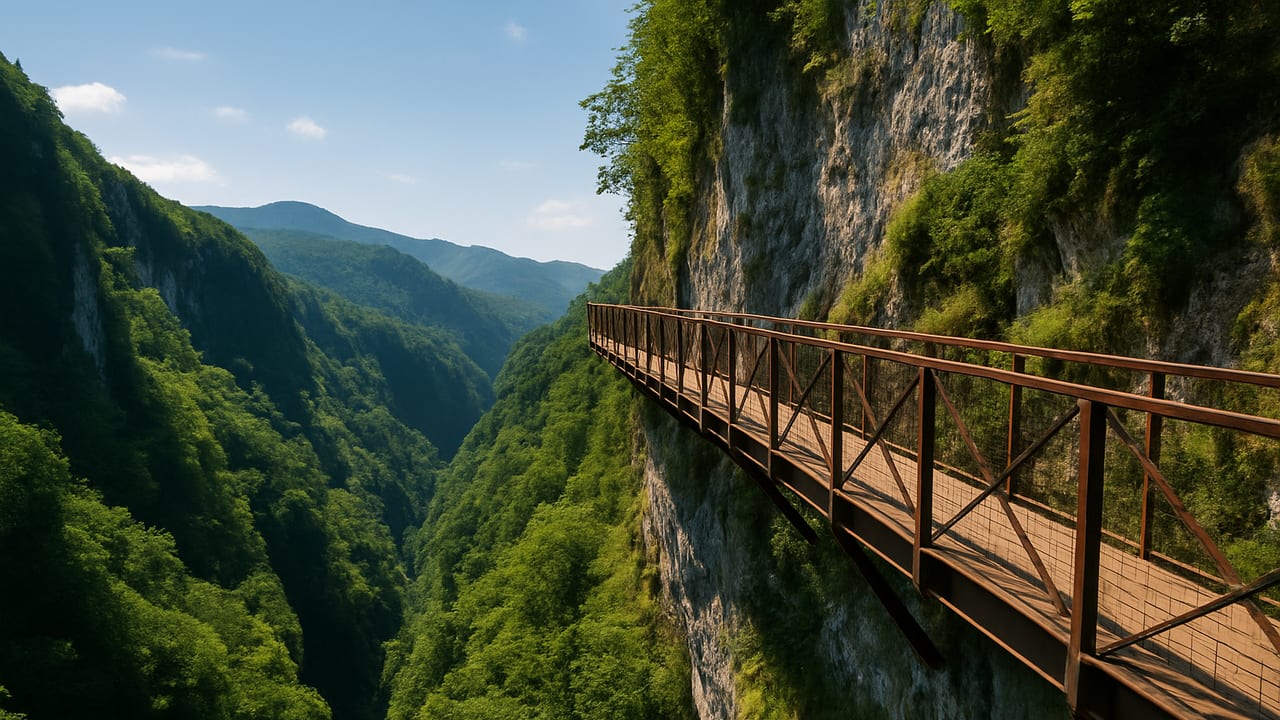
- Okatse Canyon. The more dramatic of the two canyons: a 780-meter walkway is bolted directly to the cliff face partway up the gorge, with a viewing platform that extends out over open air at the far end. The full route from the visitor center runs about 2.5 kilometers each way. Entrance is 20 GEL for foreign visitors, per the Agency of Protected Areas’ official Okatse Canyon page. It’s not a good fit for anyone genuinely uneasy with heights or exposed drops.
- Kinchkha (Okatse) Waterfall. A separate ticketed site near the same village, with its own 88-meter waterfall reached by a shorter marked trail. Often paired with Okatse Canyon on the same day since they’re a short drive apart. Entrance also runs 20 GEL for foreign visitors.
- Martvili Canyon. The gentler and, for a lot of travelers, more photogenic of the two — a short 300-meter boat ride through clear turquoise water between narrow limestone walls, with small waterfalls feeding in along the way. Entrance is 20 GEL, with the boat ride an additional 20 GEL. It gets genuinely crowded with tour groups in peak summer; an early morning or shoulder-season visit is a meaningfully better experience here than at Okatse, where the walkway spreads visitors out more.
Public transport to this cluster is thinner than to the monastery loop — a private driver, rental car, or booked tour is the more realistic option for most visitors, and it’s the cluster where that extra cost pays off the most in time saved.
East: Chiatura and the Katskhi Pillar
A genuinely different kind of day trip, about two hours from Kutaisi by marshrutka or car, and one best treated as its own full day rather than an add-on to anything else.
- Chiatura. A working manganese-mining town still connected by a network of Soviet-era cable cars, several of which have been renovated and remain in daily use by residents rather than run purely as a tourist attraction. Rides cost 50 tetri (half a lari) each way. The town itself is worth an hour or two of walking as much as the cable cars are — it’s a genuine look at Georgia’s industrial history, not a staged one.
- Katskhi Pillar. A 40-to-45-meter natural limestone column visible from the Chiatura road, topped by a small monastery where, since the 1990s, a single monk has lived in isolation. Public climbing isn’t permitted; the site is worth seeing and photographing from the base rather than expecting access to the top.
This cluster is far enough from Kutaisi, and different enough in character, that combining it with a canyon or the monastery loop in the same day isn’t realistic. Treat it as a dedicated day if Soviet-era history and infrastructure genuinely interest you — and treat the canyons or Gelati as the better use of a single free day if it doesn’t.
South: Batumi, If You Have the Time
Batumi, Georgia’s Black Sea resort city, is reachable by marshrutka in roughly two to two and a half hours each way, with fares around 15 GEL. That math is the whole reason most Kutaisi visitors either skip it or turn it into an overnight rather than a day trip: four to five hours round trip on the road leaves a comparatively thin window for the seaside promenade, old town, and botanical garden that make Batumi worth visiting in the first place. If a coastal stop matters to your itinerary, it’s a better use of your time as a one- or two-night add-on before or after Kutaisi than as a rushed there-and-back.
Costs at a Glance
Entrance fees for foreign visitors, current as of this writing and worth double-checking before you go, since several of these have changed in the past couple of years:
- Gelati Monastery: free
- Motsameta Monastery: free
- Prometheus Cave: 40 GEL, plus 30 GEL for the optional boat ride
- Okatse Canyon: 20 GEL
- Kinchkha (Okatse) Waterfall: 20 GEL
- Martvili Canyon: 20 GEL, plus 20 GEL for the boat ride
- Sataplia Nature Reserve (dinosaur footprints and a smaller cave, close to town): 30 GEL
- Chiatura cable cars: 0.50 GEL per ride
- Batumi marshrutka: roughly 15 GEL each way
A private driver or organized tour for a full day typically runs somewhere between 150 and 250 GEL, split among however many people are in the car — worth comparing against the marshrutka-plus-entrance-fee total for your specific route before assuming a tour is the pricier option.
Weather and Timing for the Canyons Specifically
Okatse and Martvili both handle rain differently than a monastery or cave visit would. Okatse’s cliffside walkway can close temporarily in poor weather or high wind, since it’s an exposed metal structure bolted to a rock face, and Martvili’s boat ride can be suspended if the river runs high after heavy rain. Spring and autumn give the most reliable combination of open trails and manageable crowds; a summer visit works but gets busy with tour groups by midmorning at Martvili in particular, so an early start matters more there than at Okatse.
A Note on Visiting Tskaltubo Respectfully
Tskaltubo’s abandoned sanatoriums photograph beautifully, and it’s easy to find guides that treat them purely as an aesthetic backdrop. That’s an incomplete picture. Some of these buildings have housed internally displaced families since the early 1990s, and people are still living in parts of them today, often in difficult conditions. Others have been sold to private investors and fenced off, and entering those specifically counts as trespassing regardless of how open a gate might look.
None of that means Tskaltubo is off-limits to visit — it’s a legitimate and genuinely striking stop, and plenty of buildings remain publicly accessible. It does mean treating any inhabited section as someone’s home rather than a photo set, staying out of buildings that are visibly fenced or marked private, and going with a local guide if you want to see the more atmospheric interiors without guessing which door is actually open to you. The buildings are also structurally uneven in places — broken flooring, exposed stairwells, damp interiors — so a guide or at least sturdy footwear matters here beyond the ethical question.
Planning the Trip Around What You Actually Have Time For
With two full days available for day trips, the monastery-and-spa loop and one canyon cluster cover the highlights without over-scheduling either day. With three days, adding either Chiatura or a Batumi overnight rounds things out, depending on whether Soviet industrial history or coastal time appeals more. With only one day, the monastery loop is the easier win logistically, but the canyons are the more memorable choice if you don’t mind a longer drive and a tighter schedule.
Whichever direction you pick first, book a private driver or organized tour if your day includes Okatse or Martvili Canyon specifically — the payoff in time saved is bigger there than anywhere else on this list, since public transport to both canyons is the thinnest of any cluster covered here.
The Takeaway
Kutaisi’s day trips are genuinely worth the hype, but they only work well when planned by direction rather than by a wish list of names pulled from different searches. Pick one cluster — the monasteries and Tskaltubo, the canyons, Chiatura, or a Batumi overnight — per day, budget roughly 20 to 40 GEL per person in entrance fees on top of transport, and treat Tskaltubo’s abandoned buildings as inhabited spaces rather than a backdrop. That’s the difference between a Kutaisi stay that feels like steady exploring and one that feels like most of the day happened on a marshrutka.
If you’re still deciding how many days in Kutaisi itself to build around these trips, our guide on whether Kutaisi is worth visiting covers that groundwork. For the canyon walkways, cave paths, and Chiatura’s uneven streets, a decent pair of waterproof hiking shoes earns its space in the bag, and a compact dry bag is worth having for the Martvili Canyon boat ride specifically, even though it’s a short one. For long marshrutka days in either direction, our guide to compression socks for cold-weather travel covers gear that matters more on multi-hour rides than most packing lists admit. For more on the wider region, our Caucasus & Central Asia destination guides cover the rest of the logistics.
Frequently asked questions
- How many day trips can you actually do from Kutaisi?
- Most travelers manage two to three in a typical stay of two or three nights: one to the monasteries and spa town north of the city, one to the canyons west of it, and sometimes a third to Chiatura or Batumi if time allows. Trying to fit more than one major direction into a single day usually means less time at each stop than the entrance fee is worth.
- Do you need a car for day trips from Kutaisi?
- No, but it helps. Marshrutkas (shared minibuses) reach Tskaltubo, Gelati, Chiatura, and the canyon turnoffs, though schedules can be infrequent and connections from a marshrutka drop-off to the actual site sometimes require a taxi anyway. A rental car or a private driver for the day removes that uncertainty, especially for Okatse and Martvili Canyons, which sit down side roads off the main routes.
- Is Okatse Canyon or Martvili Canyon better?
- They reward different things. Okatse Canyon has the better view — a hanging walkway clings to the cliff face with a real drop below it — and suits travelers who don't mind heights and want a proper walk. Martvili Canyon is calmer and more photogenic at water level, with a short boat ride through turquoise water, and suits travelers who want the payoff without the exposure. Many day tours combine both in one trip.
- Is Chiatura worth a full day trip from Kutaisi?
- If Soviet industrial history interests you specifically, yes. Chiatura and the nearby Katskhi Pillar are a different kind of day trip than the canyons or monasteries — less scenic in the conventional sense, more about seeing a working town still shaped by its Soviet-era manganese mines. If that doesn't sound appealing, the canyons or Gelati are the better use of a limited day.
- Is Gelati Monastery still worth visiting during restoration work?
- Yes, with a caveat. Ongoing conservation work has scaffolding covering much of the main church's exterior and blocks the view of some of its frescoes, but other chapels on the site, including the Church of St George, remain open, and the monastery's history and setting are still worth the short trip from Kutaisi.
- Can you visit Batumi as a day trip from Kutaisi?
- Yes, though it's the longest of the standard options at roughly two to two and a half hours each way by marshrutka. It works better as an overnight add-on to a Kutaisi stay than a rushed there-and-back, since the travel time eats a large share of the daylight you'd otherwise spend at the coast.
- How much does a typical day trip from Kutaisi cost?
- A marshrutka-based day trip to somewhere like Tskaltubo or Gelati can cost under 20 GEL round trip before entrance fees. Entrance to a single site like Okatse or Martvili Canyon runs around 20 GEL for foreign visitors, with Prometheus Cave and Sataplia Nature Reserve closer to 30 to 40 GEL. A private driver or organized tour for the day typically runs somewhere in the range of 150 to 250 GEL, split among however many people are in the car.